
“Forests Underwater”: GEO magazine’s report on Chile’s kelp forests and Costa Humboldt’s restoration work
German magazine GEO published an extensive feature on Chile’s underwater forests, the communities that depend on them, and the challenges involved in conserving them. The investigation reached Chiloé, where the magazine learned about the work carried out by Costa Humboldt to restore kelp forests and its collaboration with coastal communities.
Off the coast of Chile lies a world that remains invisible to much of society: extensive kelp forests that provide habitat for numerous species, generate biomass, contribute to carbon storage, and are part of the lives and livelihoods of coastal communities.
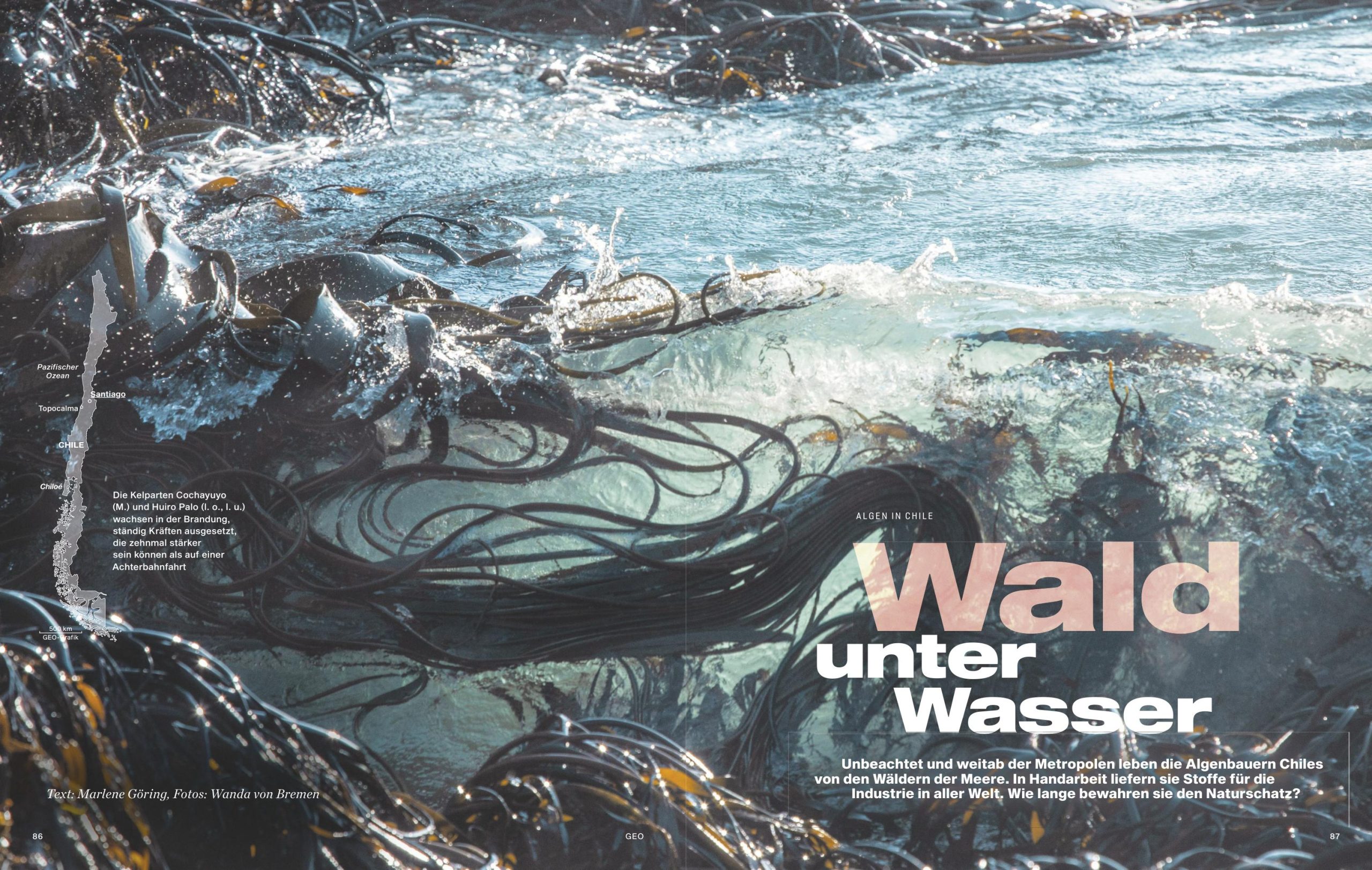
This is the world explored in “Forests Underwater”, an extensive feature published by German magazine GEO, written by journalist Marlene Göring and photographed by Wanda von Bremen.
The investigation travels along Chile’s coastline to learn about the work of seaweed harvesters, their ways of life, and the knowledge they have developed through their close relationship with the sea. From Topocalma to Chiloé, the report also highlights the pressures facing these ecosystems and the challenges of reconciling their use with their conservation.
A forest that sustains life
Among the species featured in the report is Macrocystis pyrifera, giant kelp, which can reach tens of metres in length and form dense underwater forests.
These ecosystems play fundamental roles in marine life. Their structures provide shelter for different species, serve as breeding and nursery grounds, and contribute large amounts of biomass to food webs. In addition, some of the kelp that reaches the seafloor contributes to carbon storage, while these forests help reduce wave energy and protect coastlines.
But these forests also face threats.
Overexploitation of kelp, rising sea temperatures, and other activities that place pressure on coastal ecosystems threaten their ability to recover.
Conservation also means working with communities
One of the central themes running through the report is the relationship between marine ecosystems and the communities that depend on them.
In Chiloé, the story of Angélica Jarra, president of a seaweed harvesters’ union in Chaiguao Barra, shows how local knowledge and community organization can contribute to the management and protection of natural resources.
The union carries out regular assessments of seaweed populations in order to establish harvesting quotas and has developed infrastructure to improve the drying and use of the harvest. The experience shows that conserving these ecosystems also means creating the conditions that allow communities to continue making a sustainable living from them.
It is precisely at this point that the work of Costa Humboldt becomes particularly relevant.
Costa Humboldt: science for restoration
GEO visited several communities where Costa Humboldt has ongoing projects, with a particular focus on its work reproducing Macrocystis pyrifera from spores.
In the laboratory, researchers develop young kelp specimens that can later be transferred to the sea, with the aim of helping restore kelp populations that have declined.
The initiative also seeks to create new alternatives for seaweed-harvesting communities: providing healthy parent plants that can be used to restore populations in the ocean, thereby reducing pressure on natural specimens.
As stated by Alejandra Núñez, head of the kelp research station working alongside Costa Humboldt, who was interviewed for the report, “This work is part of a conservation approach that connects scientific research, ecological restoration, and collaboration with the communities that inhabit and depend on coastal territories.”
GEO’s own reporting shows that this dialogue is fundamental. Scientific research still has much to learn about these ecosystems, while those who have built their lives around them possess knowledge and experience that are essential to understanding and conserving them.
A new perspective on our underwater forests
GEO’s report offers a closer look at an extraordinary ecosystem and, at the same time, at the people who depend on it and work to conserve it.
Kelp appears not only as an economic resource or raw material for industries around the world, but as part of complex ecosystems and territories where nature, culture, livelihoods, and knowledge are deeply interconnected.
Costa Humboldt contributes to this challenge through research, kelp forest restoration, and collaboration with coastal communities, seeking to generate knowledge and tools that can help advance toward a more sustainable relationship with these ecosystems.
The report in GEO
“Forests Underwater”
Text: Marlene Göring · Photography: Wanda von Bremen
